Every AI agent is a non-human identity acting on your behalf. Give it the keys before you've decided what it's allowed to touch, and you've built your next incident.
AI is the push right now — from the boardroom, from your platform vendors, from us. And the promise is real: agents that reach into your systems, act on your behalf and get work done without a human in every loop. 🤖
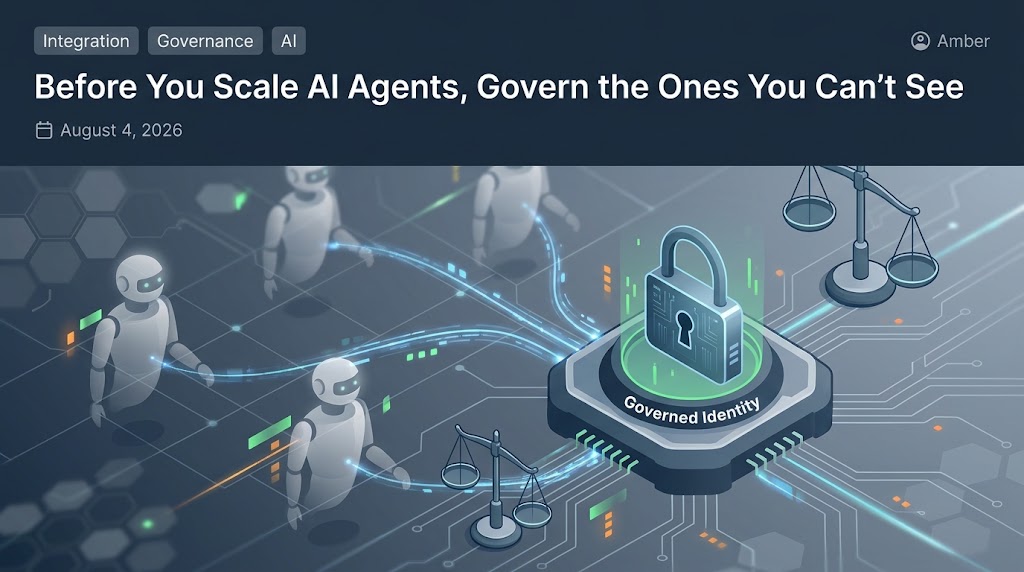
But there's a quiet truth underneath the excitement. An AI agent is only as useful as the systems it can safely reach — and every agent you deploy is a non-human identity acting on someone's authority. If you're scaling agents faster than you're governing the identities behind them, you're not scaling capability. You're scaling exposure. Let's unpack it. 👇
🔑 The thing nobody's putting on the slide
For years, "identity" meant people — usernames, passwords, access reviews. That model quietly stopped being the whole picture. Every integration, every service account, and now every AI agent is an identity that can read, write and act across your estate. They already outnumber your human users, often many times over.
Most organisations govern the human identities carefully and the non-human ones barely at all. Agents make that gap urgent, because an agent doesn't just hold access — it decides how to use it, at machine speed, in situations you didn't script.
📡 Sound familiar?
You don't need a security review to know the gap is there. You can hear it:
| What you're saying | What it's really telling you |
|---|---|
| "Let's give the agent broad access so it can be useful." | Convenience is about to become your blast radius. |
| "We're not totally sure what that service account can reach." | You have ungoverned non-human identity already — before any AI. |
| "The agent worked in the demo." | Demos don't have adversaries, edge cases or a Monday. |
| "Security will look at it before we go live." | Governance is being discovered late, under deadline — the expensive way. |
| "We'll tighten permissions once it's proven." | Permissions granted broadly are almost never walked back. |
🔒 What good looks like
You don't govern AI agents with a policy document. You govern them by building the foundation before you scale — the same foundation good integration needs anyway.
Give every agent a scoped identity. Not a shared, all-powerful account. Each agent gets its own identity with the narrowest access that lets it do its job — and nothing beyond it.
Decide what it's allowed to reach, in advance. Before an agent goes near production, decide which systems, data and actions are in bounds. Design it in; don't discover it under incident pressure.
Route agents through a governed layer, not straight into systems. When agents reach the business through a governed integration platform rather than bespoke point-to-point access, you get one place to see, control and revoke what they do. Governance becomes a property of the architecture, not a promise.
Log and monitor non-human activity like it matters — because it does. You want to answer "what did this agent do, and was it allowed to?" instantly, not during a post-mortem.
Do this and something useful happens: it's one migration, not two. The governed platform that makes your integration reusable is the same platform that makes your AI agents safe to scale. Build it once.
Give an agent broad access because it's convenient, and you haven't deployed a capability. You've pre-authorised your next incident.
🤔 "But what about…" — two honest answers
"This sounds like it'll slow the AI push down." It's the opposite. The thing that actually stalls AI programmes is the security review that lands late and sends everyone back to the drawing board. Govern identity up front and you go faster, because there's no rework and nothing to defend after the fact.
"We just want to experiment — isn't this overkill for a pilot?" Experiment freely in a sandbox with no real access. The discipline only has to be there before an agent touches production data or takes real actions. That line is the one worth holding.
✅ Where to start
You don't need an enterprise AI governance programme to begin. You need to see what's already ungoverned and put one agent on rails:
🎯 Inventory the non-human identities you already have — service accounts and integrations included. Most teams are surprised.
🔐 Pick the first agent use case and decide, up front, exactly what it's allowed to reach.
🚀 Route it through a governed layer and prove the model before you scale to the next.
This piece reflects integration and security delivery experience; specific controls should be mapped to your own risk, regulatory and platform context.
🤝 The ask is a short, bounded look at your non-human identities and your first agent use case — what's already exposed, and what it takes to scale AI without scaling risk alongside it.