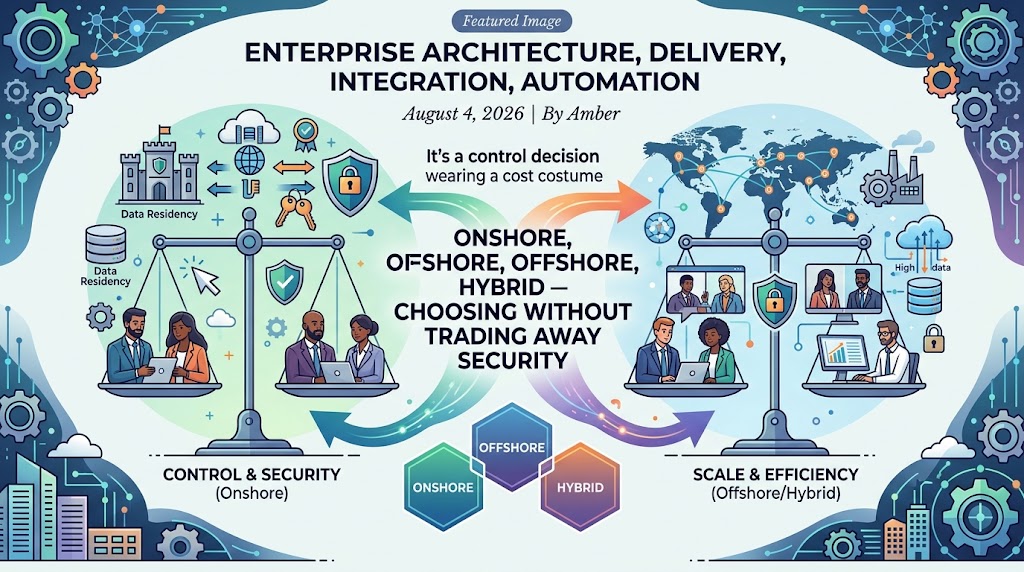
Why a fractional Enterprise Architect is the smartest hire you'll never make full-time.
Here's an uncomfortable number to start with. Most organisations spend 60–80% of their IT budget just keeping old systems running — not building anything new, not delighting a single customer, just holding the past together with tape and goodwill. 🔦
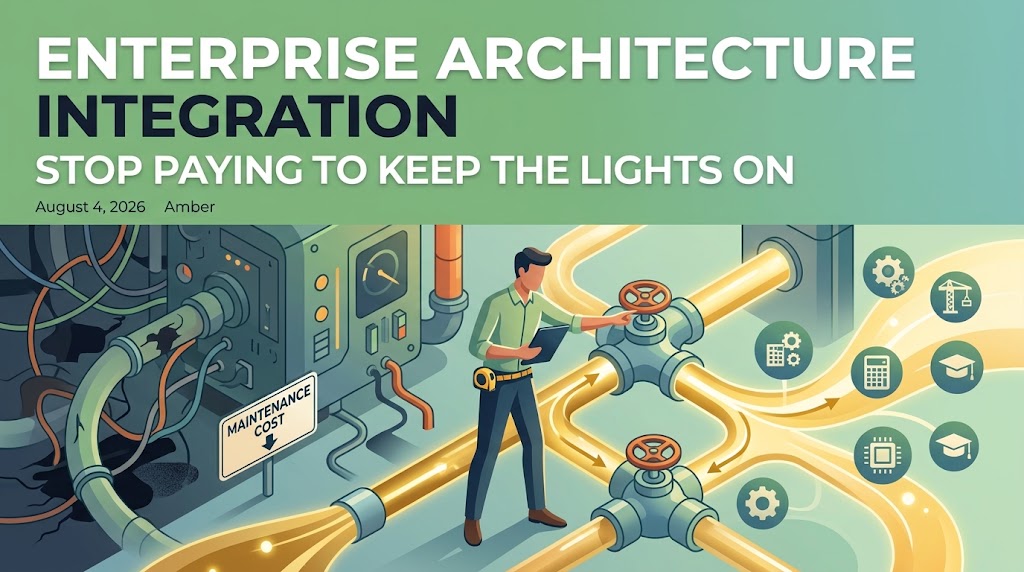
If that stings a little, good. Because it means the biggest opportunity in your business probably isn't a new product or a new market. It's the money you're already spending, trapped in the plumbing between your systems, quietly leaking value every single day.
The good news: you don't need a small army of architects on the payroll to fix it. You need the right thinking, at the right moments, sized to what you need. That's what a fractional Enterprise Architect does. Let's unpack it. 👇
🧾 The hidden tax on every ambition
Every organisation is trying to change — a new ERP, a merger, a modernisation push, a growth spurt. And nearly everyone hits the same invisible wall: their systems don't talk to each other cleanly.
It rarely shows up as a line item. Instead, it hides in plain sight as a hundred small frustrations:
- The same customer or job number lives in five systems — and no two agree. 🤷
- Every new integration is hand-built, brittle, and takes months. ⏳
- A legacy system nobody fully understands has quietly become mission critical. 😬
- Your best people spend their week firefighting instead of building. 🔥
This is the tax you pay for fragmentation. And because it's spread across dozens of budget lines, most organisations underestimate it by 40–60% — which is exactly why leaders feel the pain long before they can name it.
🧭 What a fractional Enterprise Architect does
Think of it as senior architecture leadership on demand — the strategic brain of a big-tech transformation team, without the big-tech headcount. The work follows five simple moves:
| The move | What it means for you |
|---|---|
| 🧭 Set the North Star | One shared strategy for integration and automation that IT, data and the business all rally behind — no more one-off, point-to-point fixes. |
| 🔍 Choose on evidence | A transparent, rigorous platform evaluation — not a vendor's sales pitch — so leadership trusts both the process and the result. |
| 🏗️ Design once, reuse forever | A secure, event-driven blueprint with a single source of truth and reusable patterns, so future work takes weeks, not months. |
| 🚀 Prove it in production | A real, working integration live in your environment early — value the board can see, not a slide-deck promise. |
| 🔑 Hand over the keys | A lean Centre of Excellence and an upskilled team, so you own the capability and aren't hooked on consultants forever. |
The shorthand? A North Star, a governed platform, first value in production, and an in-house capability that keeps compounding — without the cost and lock-in of a big permanent team.
📈 The payoff, in plain terms
Strategy decks are easy to nod along to and easy to forget. So here's what changes when the plumbing gets fixed properly:
⚡ Speed: delivery moves from months to weeks, turning a backlog into throughput.
🔒 Safety: one governed, secure platform replaces fragile hand-built connections — closing audit and pen-test findings.
🎯 Trust: a single source of truth ends duplication and reconciliation, so everyone works from the same number.
💰 Value: enterprise-grade expertise at a fraction of the cost of a permanent team — no idle payroll.
🌱 Ownership: an in-house capability you control, delivering value that compounds long after the engagement ends.
🔢 Don't take our word for it
The evidence for getting integration and architecture right is well established across industry research:
| The number | What it tells you |
|---|---|
| 60–80% | Share of IT budgets spent maintaining legacy systems (McKinsey) — money that buys no new value. |
| 20% / 30% | Up to a 20% cut in IT operating cost and a 30% lift in productivity from a mature enterprise-architecture practice (Gartner). |
| ~70% | Reduction in integration build time when moving from hand-coding to a governed platform — the engine behind 'months to weeks'. |
| 380–445% | Three-year ROI reported in independent studies of enterprise integration platforms, driven by faster delivery and redeployed staff. |
🏭 The same fix, tailored to your world
Fragmentation looks a little different in every sector — but the cure is remarkably consistent. Wherever you sit, there's a door in:
| Sector | The pain they feel | The fix that lands |
|---|---|---|
| 🏗️ Construction & Energy | Project, cost and vendor data scattered across finance, field service and CRM; ERP rollouts stalling. | A single source of truth and a governed hub around the new core — fast, without a big team. |
| 🛠️ Manufacturing & Retail | Fragile, batch-based links between order, design and installer systems; sign-offs that miss scheduling. | Real-time, event-driven order flows and a safe path to retire fragile legacy. |
| ⚖️ Legal & Professional | Point-to-point integration and per-request data access slowing every matter; strict confidentiality. | A governed, reusable platform with compliance and privilege designed in — no new headcount. |
| 🎓 Higher Education | Automation demand from every department, unqualified and ad-hoc; peaks at Clearing and Enrolment. | A Centre of Excellence with value-first intake, plus surge support for peak periods. |
| 🏦 Banking & Finance | Legacy cores eating the IT budget; integration as the top blocker to launching anything new. | Secure connectivity to legacy without new exposure, and phased modernisation that de-risks change. |
| 📡 Telecommunications | Sprawling estates from years of growth and acquisition; overlapping, duplicated systems. | A reusable, event-driven platform for rapid service change and system consolidation. |
| 🏛️ Government & Public Sector | Most of the budget locked in legacy upkeep; strict security, transparency and probity demands. | Evidence-based, defensible platform choices and governed integration the department owns. |
🤔 "But what about…" — three honest answers
"We already have an integration team." Perfect — this makes them faster and safer, not redundant. We set the direction and the reusable patterns so they stop rebuilding plumbing and start shipping. We build their skills, not a dependency.
"We can't take on a big consulting bill." That's the whole point of fractional. You get senior leadership sized to what you need — and it typically pays for itself by shrinking the 60–80% you're already spending on maintenance.
"Why not just rip out the old system?" Big-bang replacements are where budgets and reputations go to die. We phase it — prove value on one real flow, then retire the legacy risk safely, on a clear timeline.
✅ Where to start
You don't need to boil the ocean. You need one honest conversation and one first win. If any of this sounds like your organisation, the next step is simple:
🎯 Pick the single integration or process that hurts most right now.
🧾 Get a clear read on what it's really costing you — the tax is bigger than it looks.
🚀 Prove the model on that one thing, in production, before scaling.
Figures cited are drawn from published industry research (Gartner, McKinsey and independent integration-platform ROI studies) and are directional rather than guarantees; actual results vary by organisation.
💡 The reframe: You don't have a technology problem. You have a connection problem — and connection is the cheapest, fastest lever you have to unlock value you've already paid for.
📌 The line worth remembering: the goal is to move money from maintenance to momentum — and prove it with a real result in production, fast.
🤝 Ready to move money from maintenance to momentum? Let's find your first win — a real result in production — and build a capability your team owns long after we're done.